
Plano is where Staggs Plumbing lives. Our office is downtown on F Avenue, our trucks run these streets every day, and after three decades here we know this city’s plumbing the way you only can from the inside: which neighborhoods were plumbed with which pipe, in which decade, and what fails first.
That matters for slab leaks more than for almost any other repair, because the right fix depends on what’s under your specific house, and in Plano that answer changes street by street. For homes outside the city, see our slab leak repair across Dallas-Fort Worth, or explore all of our plumbing services in Plano.Why Plano Homeowners Call Staggs Plumbing
Headquartered in Plano
Our office is at 740 F Avenue in downtown Plano, minutes from your home.
Family-Owned Since 1990
More than three decades of Plano slab leak repair. Meet our team.
Texas Master Plumber #M-17697
Held by Randy Staggs and verifiable with the Texas State Board of Plumbing Examiners.
24/7 Emergency Response
About a 45-minute average arrival, with Plano at the center of our service area. See our emergency plumbing.
Upfront Flat-Rate Pricing
A written price before anything starts.
Warranties You Can Count On
5-year warranty on spot repairs, lifetime on full reroutes, and 2-year labor on all other work.
Financing & 0% Options
Plumbing financing for larger repairs, reroutes, and repipes.
English & Spanish
Service in English and Spanish, plus insurance documentation support on every slab leak job.
What is a slab leak?
A slab leak is a break in one of the pipes running underneath your home’s concrete foundation: either a pressurized copper water line or a cast-iron or PVC sewer line. Nearly every Plano home is built slab-on-grade, meaning the concrete was poured directly over the plumbing and the dirt. When a buried pipe cracks, corrodes through, or separates at a joint, the water has nowhere to go but into the soil, up through the slab, or out along the foundation.- Water-line leaks announce themselves faster. The line is under constant pressure, so it pushes water out around the clock.
- Sewer-line leaks are quieter. With no pressure behind them, they can seep for months or years, washing out the soil that holds your foundation level the whole time. Learn what causes sewer line damage in DFW.
How do I know if I have a slab leak?
Most slab leaks show at least one of these signs before they become obvious. One alone is not proof, but two or more means it’s worth a test.- A warm or hot spot on the floor. Heat under the slab almost always means a hot-water line is leaking. There’s no innocent explanation for it in a Texas home.
- A water bill that jumped with no change in usage. A pressurized leak runs 24/7. A sudden, unexplained increase is a classic tell. See what causes a high water bill in Plano.
- Running-water sounds with everything off. Shut off every faucet and appliance, then listen near the floor. A faint hiss points to a pressurized leak.
- Cracked tile in a line, buckled flooring, or damp spots with no roof or appliance above them.
- A sewage smell you can’t track down, a possible broken drain line seeping under the slab.
- Doors that suddenly stick or fresh drywall cracks. When a leak washes out supporting soil, the foundation moves, and the house moves with it.
- A water heater that never seems to stop running. A hot-water slab leak keeps the tank refilling and reheating around the clock.
Why do Plano homes get so many slab leaks?
Plano’s growth story is written in its pipe. The east side and the neighborhoods around downtown were largely built in the 1960s and 70s; the great middle of the city filled in through the 80s; the west side toward Legacy came up in the late 80s and 90s. That means most of Plano sits on copper supply lines and cast-iron drains that are now 30 to 50 years old, right at, or past, the end of their design life.
Under all of it is the same expansive Blackland Prairie clay that runs through the heart of North Texas. It swells hard when wet and shrinks hard when dry, and every cycle drags the buried pipe along for the ride. Add our moderately hard water working on the inside of aging copper, and you get the slab-leak pattern we’ve answered in Plano for 35+ years: original-era pipe, moving clay, time. Read more about clay soil, copper pipe, and slab leaks.Slab leak risk by Plano neighborhood
East Plano and downtown
The original 1960s and 70s brick ranches, where copper supply lines and cast-iron drains are among the oldest in the city. Cast iron here can crack or corrode through, so we often camera-inspect drains along with testing the water lines.
Central Plano and Dallas North Estates
1970s and 80s homes, including the two-stories off Custer Road, where under-slab copper is now at the age when pinhole leaks start showing up in clusters.
West Plano, Willow Bend, and Deerfield
Late 80s and 90s construction. Some homes from roughly 1978 to 1995 may have polybutylene supply pipe, which is worth checking whenever a leak appears.
Legacy and far north Plano
Newer 90s and 2000s homes, often on post-tension slabs with steel cables in the concrete, which makes precise leak location before cutting even more important.
East toward Murphy and Parker
Larger lots and longer runs between the meter and the house, so we test the yard line as well as the slab.
Call volume here climbs after weather swings: late summer when the clay is cracked dry, and again after the first heavy rains rehydrate it. If your street just went through a drought-then-downpour cycle, that’s prime slab-leak season.
The home-field advantage: why headquarters location matters
Every plumber says they serve Plano. We’re from Plano. The company has been based here since Randy Staggs founded it in 1990, and our headquarters is at 740 F Avenue, Suite 302, a few blocks from the downtown station. In practice that means three things for a Plano slab leak:Response time
Plano sits at the center of our 45-minute average emergency response area. Our trucks are already working this city every day.
Neighborhood knowledge
We’ve opened slabs in east Plano originals, 80s two-stories off Custer, and 90s builds near Legacy. We usually know what pipe we’ll find before we arrive, which shapes the repair recommendation.
Accountability you can drive to
Our office is a real place in your city, not a call center. The license on the wall, Texas Master Plumber M-17697, is verifiable with the state.
How do you find a slab leak without tearing up my house?
This is the whole game. Our leak detection in Plano locates the leak before we open anything, layering three non-invasive methods depending on the situation:1. Electronic line tracing & pressure testing
Isolates which line is failing and roughly where it runs.
2. Acoustic listening equipment
Amplifies the sound of water escaping under concrete, narrowing the location to a small radius.
3. Thermal imaging
Reads a hot-water leak’s heat signature through the floor, with a sewer camera to inspect drain lines from the inside.
How are slab leaks repaired?
There’s no single right repair. It depends on where the leak is, how the pipe was run, and how much of the system carries the same risk. After we locate the leak, we walk you through the realistic options and what each costs before any work starts.
- Flat-rate pricing on every option before work begins
- 5-year warranty on spot repairs
- Lifetime warranty on full reroutes
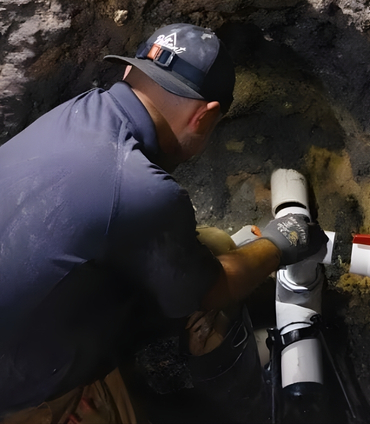
| Method | Best when… | Tradeoff |
|---|---|---|
| Spot repair (open & fix) | The leak is isolated, the pipe is otherwise sound, and it’s reachable | Fastest and lowest cost; opens a small section of floor |
| Reroute / re-pipe the line | The pipe is old, hard to reach, or has leaked more than once | Abandons the bad line by running new pipe overhead or through walls; avoids future leaks on that run |
| Whole-home repipe | Original copper across the house is failing in multiple spots | Highest upfront cost, but solves the underlying problem instead of chasing leaks one at a time |
| Sewer line repair | A cast-iron or PVC drain has broken under the slab | May involve trenching or, where suitable, trenchless methods; we confirm with the camera first |
Recent project: slab leak tunnel repair in central Plano
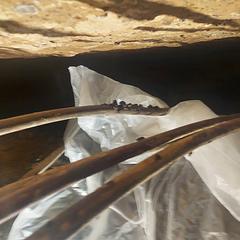
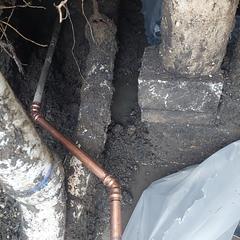
A central Plano homeowner called us about signs of a hidden leak. Our team traced it to a cold water line under the slab, about 10 feet in from the nearest exterior wall, directly beneath the kitchen. Here’s how we fixed it without touching the kitchen floor.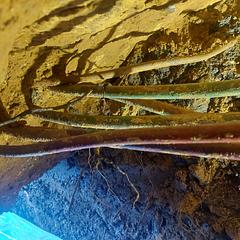
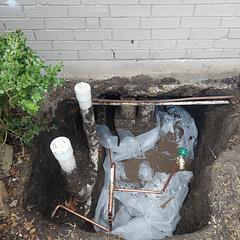
Swipe or scroll to see all 4 photos →
- The challenge: Reaching the leak from inside would have meant breaking up the kitchen floor and cabinets.
- Our solution: We dug a 10-foot tunnel under the foundation from outside the home to reach the line without opening the floor.
- The repair: The damaged section was replaced with new copper pipe and copper fittings.
- The result: The leak was fixed, the kitchen stayed untouched, and the home was protected from further water damage and soil movement.
How we handle a slab leak call
Confirm & locate
We verify there’s a leak and pinpoint it with electronic, acoustic, and thermal tools before opening anything.Show you the options
You see what we found and get upfront, flat-rate pricing on each realistic repair. No work starts until you say go.Make the repair
A licensed master plumber does the work (spot repair, reroute, repipe, or sewer fix) with the smallest footprint the job allows.Test & warranty
We re-test to confirm the leak is gone and back the work: 5-year warranty on spot repairs, lifetime warranty on full reroutes, 2-year labor warranty on all other work.What does slab leak repair cost in Plano?
Anyone who quotes a slab leak over the phone without seeing it is guessing. The honest answer: it depends on the detection, the repair method, and how the line was run. What we promise is no mystery math:- A written flat-rate price before we start, with a clear explanation of why one option costs what it does.
- Financing available.
Think you have a slab leak? Start here.
Three things to do today, in order:
- Do the meter test. Shut off all water inside and out, then check whether the meter’s leak indicator keeps moving. Movement with everything off means water is escaping. Here’s how to detect a hidden water leak.
- If a hot spot, active water, or fast-rising bill is involved, shut off the water at the main to stop the damage, and call a licensed plumber to locate it.
- Don’t let anyone break concrete to “look.” The leak should be located with detection equipment first. Exploratory demolition is how floors get destroyed for nothing.
Signs it’s time to call a plumber
Call us to test for a slab leak if you notice any of these. The earlier it’s caught, the less it costs and the less foundation damage it does:- A warm spot on the floor, or a water bill that climbed with no change in habits.
- Running-water sounds with every fixture off, or low water pressure that came on suddenly.
- Damp flooring, cracked tile in a line, or a sewage smell you can’t track down.
- You’re buying or selling a Plano home and want the water and sewer lines tested first with a plumbing inspection.
- You’re having foundation work done. A slab leak test is usually required, and always smart, before piers go in.
Slab leak repair near Plano
Plano is our home base, and the same crews cover the cities around it every day. If you live just across the line, start with your local page:Plano slab leak FAQ
How much does slab leak detection cost in Plano?
Can a slab leak be fixed without breaking my floor?
Will my homeowners insurance cover a slab leak in Texas?
Why do Plano homes get so many slab leaks?
How fast can you get to a Plano address?
Do you offer 24/7 emergency slab leak service in Plano?
How long does slab leak repair take in Plano?
Is a slab leak an emergency?
Can a slab leak damage my foundation?
What is the difference between leak detection and slab leak repair?
Should I get a slab leak test before buying a home in Plano?
Nearby, we also handle slab leaks in Frisco, Richardson and Carrollton.

