



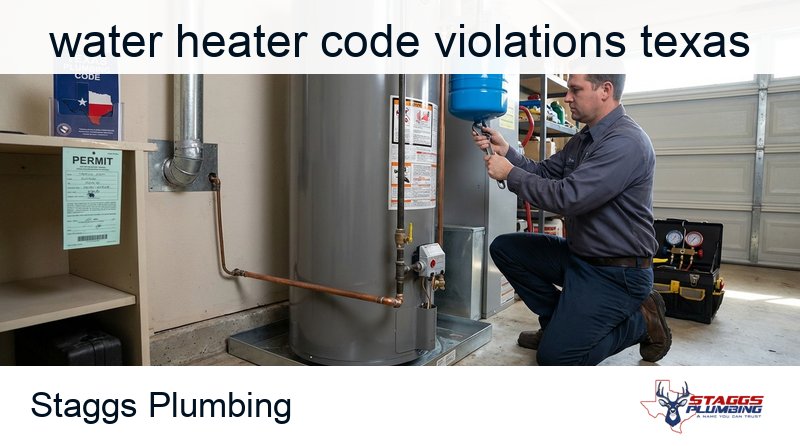
The Most Common Water Heater Code Violations in Texas
Texas requires a permit for every water heater installation, and the state doesn’t treat violations as suggestions. If your water heater has a code issue, you could be facing a genuine safety hazard (explosion, carbon monoxide, scalding), insurance denial on a future claim, or complications when you sell your home. The good news: most code violations are correctable, and many homeowners discover them during a routine home inspection or insurance review rather than after something goes wrong.
So is your water heater actually dangerous? It depends on the violation. A missing expansion tank is a liability, but it won’t explode tomorrow. An improperly routed T&P discharge line or a venting defect on a gas unit is a different story entirely. Can you get fined? Yes. Texas municipalities can issue citations for unpermitted work, and some cities in the DFW area actively enforce permit requirements on water heater replacements. Will your insurance cover damage from a non-compliant water heater? Most policies exclude coverage for damage resulting from work that wasn’t permitted or didn’t meet code. And yes, you do need a permit to replace a water heater in Texas. State law has required it since 2007.
Below, you’ll find the specific violations Texas inspectors flag most often, the severity of each, what corrections typically cost, and when you can handle something yourself versus when you need a licensed plumber.
Why Texas Requires Water Heater Code Compliance
Texas plumbing code is governed by the Texas State Board of Plumbing Examiners (TSBPE) and is based on the International Plumbing Code (IPC) with state-specific amendments. Every city and county can add local requirements on top of the state code, which is why Plano, Frisco, McKinney, and Allen each have slightly different inspection processes.
The purpose isn’t bureaucracy. Water heaters operate under pressure, produce combustion gases (gas units), and store large volumes of hot water. A single installation defect can cause an explosion, a house fire, carbon monoxide poisoning, or thousands of dollars in water damage. Code compliance is the minimum standard that prevents those outcomes.
| Authority Level | Governs |
|---|---|
| TSBPE (state) | Licensing, permit requirements, minimum code standards |
| IPC (adopted code) | Technical installation requirements |
| Local municipality | Permit fees, inspection scheduling, additional requirements |
In 40+ years of water heater work across the DFW metroplex, Staggs Plumbing (TX License #17697) has seen every violation on this list. What follows is what inspectors actually flag, not a textbook summary.
Most Common Water Heater Code Violations in Texas
Here’s a quick-reference table of the violations Texas homeowners encounter most often. Each one is covered in detail in the sections below.
| Violation | Risk Level | Typical Correction Cost |
|---|---|---|
| Improper T&P discharge piping | High (scalding, explosion) | $150 – $400 |
| Missing or incorrect venting | High (CO poisoning, fire) | $200 – $800 |
| No combustion air supply | High (CO poisoning) | $200 – $600 |
| Missing expansion tank | Moderate (pressure damage) | $150 – $300 |
| No drain pan or improper drain | Moderate (water damage) | $100 – $250 |
| Insufficient garage elevation | High (fire, explosion) | $200 – $500 |
| Missing permit / no inspection | Administrative + insurance risk | $75 – $250 (permit fee) |
| Improper gas connections | High (fire, explosion) | $150 – $500 |
The risk levels above reflect real-world consequences. “High” means the violation creates an immediate or near-term safety hazard. “Moderate” means property damage is likely if the violation goes unaddressed.
T&P Relief Valve and Discharge Violations
The temperature and pressure (T&P) relief valve is the single most critical safety device on your water heater. It opens automatically if water temperature exceeds 210 degrees or tank pressure exceeds 150 PSI, releasing water to prevent a catastrophic tank failure. Without it functioning properly, your water heater is a pressurized bomb.
Common T&P violations Texas inspectors flag:
- Discharge pipe terminated above the floor (must extend to within 6 inches of the floor or to an approved drain)
- Discharge pipe reduced in size (must match the valve outlet, typically 3/4 inch)
- Discharge pipe routed uphill or with a trap that could block flow
- T&P valve missing entirely or replaced with a plug or cap
- Discharge pipe terminated outside where it could freeze and block
- No T&P valve installed on a replacement unit
If your T&P discharge line ends in mid-air above the water heater or has been capped off, get it corrected immediately. This isn’t a “when you get around to it” repair. A failed T&P system can cause a tank rupture that launches a water heater through a roof. It has happened.
Venting and Combustion Air Violations
Gas water heaters produce combustion byproducts, including carbon monoxide. Proper venting removes those gases from your home. Proper combustion air supply ensures the burner gets enough oxygen to burn cleanly. When either system fails, CO can build up inside the house with no visible warning.
Venting violations to watch for:
- Single-wall vent pipe used where double-wall is required (passing through walls, ceilings, or enclosed spaces)
- Vent pipe diameter smaller than the draft hood outlet
- Improper vent slope (must rise 1/4 inch per foot toward the chimney or termination)
- Vent connections not secured with sheet metal screws
- Shared vent with a furnace that isn’t properly sized for both appliances
- Vent termination too close to windows, doors, or air intakes
Combustion air violations:
- Water heater installed in a sealed closet with no combustion air openings
- Air openings blocked by storage, insulation, or shelving
- Combustion air ducts undersized for the BTU rating of the appliance
Backdrafting is the most dangerous result of venting and combustion air problems. When the water heater can’t exhaust properly, it pulls combustion gases back into the living space. Staggs Plumbing performs CO safety checks on every gas water heater service call because this violation can be invisible until someone gets sick.
Drain Pan, Expansion Tank, and Water Damage Prevention
These violations won’t cause an explosion, but they can cause thousands of dollars in property damage.
Drain pan requirements:
Texas code requires a drain pan under any water heater installed in a location where a leak could cause damage to the structure. In practice, this means almost every indoor installation, especially in attics, utility closets, and garages above living spaces. The pan must have a drain line that routes water to an approved location (exterior or approved drain), not just sit there collecting water with no outlet.
Expansion tank requirements:
An expansion tank is required whenever the water supply system is “closed,” meaning a backflow preventer, pressure-reducing valve, or check valve prevents expanded water from pushing back into the municipal supply. Most DFW homes built after 2000 have a backflow preventer on the main line. If yours does and you don’t have an expansion tank, your system pressure spikes every time the water heater fires. That accelerated pressure cycling damages valves, flex connectors, and the tank itself.
| Component | When Required | What Happens Without It |
|---|---|---|
| Drain pan with drain line | Indoor installations where leak causes structural damage | Slow leak floods attic, closet, or garage; insurance may deny claim |
| Expansion tank | Closed-loop water systems (backflow preventer present) | Pressure spikes damage T&P valve, tank, fittings; shortened water heater life |
Permit and Inspection Violations
Since 2007, Texas state law requires a plumbing permit for water heater replacement. This isn’t optional, and it isn’t just a formality.
What a missing permit means for you:
- Insurance: Many insurers deny claims for water damage caused by an unpermitted water heater installation. If your unit leaks and floods your home, the first thing the adjuster checks is whether a permit was pulled.
- Home sale: A buyer’s inspector will flag an unpermitted water heater. Some buyers walk. Others demand a price reduction or require correction before closing.
- Fines: Municipalities in the DFW area can issue fines for unpermitted plumbing work. Amounts vary by city, but $200 to $500 is common.
- Liability: If someone is injured due to a code violation on an unpermitted installation, the liability falls squarely on the homeowner or the unlicensed person who did the work.
How to tell if your water heater was installed without a permit:
Check for a city inspection sticker on the unit or nearby wall. You can also call your city’s building department with your address. They keep permit records. If there’s no record of a permit for a water heater installed after 2007, it was done without one.
Staggs Plumbing pulls permits and coordinates city inspections on every water heater replacement. It adds a step to the process, but it protects the homeowner and ensures the installation meets current code.
What Happens If You Have a Code Violation
The consequences of a water heater code violation depend on the type and severity.
Safety violations (T&P, venting, gas connections, combustion air):
These create immediate risk. A venting defect could expose your family to carbon monoxide tonight. A missing or improperly piped T&P valve could fail to protect against a pressure event. These need correction now, not next month.
Property damage violations (drain pan, expansion tank):
These create cumulative risk. Your water heater might run fine for years without an expansion tank, but the excess pressure is slowly wearing out components. When something finally fails, the damage can be extensive and your insurance claim may be denied because the installation didn’t meet code.
Administrative violations (missing permit):
These create financial and legal risk. You won’t face consequences until you try to file an insurance claim, sell your home, or get caught during a complaint-driven inspection. But when that moment comes, the cost of correcting the violation is always higher than it would have been to do it right the first time.
| Consequence | Safety Violations | Property Violations | Permit Violations |
|---|---|---|---|
| Immediate danger | Yes | No | No |
| Insurance denial risk | High | Moderate | High |
| Home sale impact | Must correct | Should correct | Must correct |
| Typical correction cost | $150 – $800 | $100 – $300 | $75 – $250 (permit) + any code corrections |
How to Get Water Heater Code Violations Fixed
Some issues a homeowner can identify. Fewer are safe to fix yourself.
What you can check on your own:
- Look at the T&P discharge pipe. Does it run down to within 6 inches of the floor or to a drain? Or does it end in mid-air or point upward?
- Check for a drain pan under the unit. Is there a drain line connected to it?
- Look at the vent pipe on a gas unit. Is it connected securely? Does it slope upward?
- Check for a city inspection sticker.
- Look for an expansion tank (small tank, usually mounted on the cold water line above the water heater).
What requires a licensed plumber:
- Any gas line work (connections, shutoffs, sediment traps)
- Venting modifications or replacements
- T&P valve replacement or discharge pipe rerouting
- Expansion tank installation (involves system pressure assessment)
- Pulling a permit and scheduling a city inspection
- Correcting combustion air deficiencies
Texas law requires a licensed plumber for water heater installation and gas line work. DIY water heater installations are not legal in Texas without a plumbing license, and unpermitted work creates the same insurance and liability problems described above.
If you’ve found a code violation or suspect one, the most cost-effective path is a professional inspection. Staggs Plumbing evaluates water heater code compliance as part of every water heater service call and can typically correct most violations in a single visit.
Frequently Asked Questions
Can I install my own water heater in Texas without a plumber?
Can I install my own water heater in Texas without a plumber?
No. Texas requires a licensed plumber to perform water heater installations. Homeowners cannot legally pull their own plumbing permits for water heater work. Doing so creates permit violations, insurance exposure, and potential liability if someone is injured.
Are code requirements different for tankless versus tank water heaters in Texas?
Are code requirements different for tankless versus tank water heaters in Texas?
Yes. Tankless units have additional requirements for gas line sizing (higher BTU demand), venting (typically category III or IV stainless steel vent), and condensate drainage (condensing models). The core safety requirements like T&P valves and permits apply to both types.
What if my water heater was code-compliant when installed but code has changed since?
What if my water heater was code-compliant when installed but code has changed since?
Existing installations are generally grandfathered under the code that was in effect at the time of installation, as long as the work was permitted and inspected. However, if you replace the water heater, the new installation must meet current code. Some safety-critical defects (like venting problems) should be corrected regardless of grandfathering.
How much does it cost to fix water heater code violations?
How much does it cost to fix water heater code violations?
Most individual corrections run $100 to $500. A missing expansion tank installation is typically $150 to $300. T&P discharge pipe corrections run $150 to $400. Venting corrections vary widely ($200 to $800+) depending on the scope. If multiple violations exist, bundling corrections with a water heater replacement is often the most cost-effective approach.
Do older homes get grandfathered in on water heater code requirements?
Do older homes get grandfathered in on water heater code requirements?
The existing water heater installation is grandfathered, but any new work must meet current code. If you’re selling your home, a buyer’s inspector will still flag conditions that don’t meet current standards, even if they were legal when installed. The practical reality is that you’ll likely need to bring things up to current code at the point of sale or replacement.
Staggs Plumbing has spent 40+ years installing and servicing water heaters across Plano, Frisco, McKinney, Allen, and the greater DFW area. Every installation includes permits, city inspection coordination, and full code compliance. TX Master Plumber License #17697. BBB A+ rated and accredited since 2014. Call 682-284-0966 for a water heater code compliance evaluation or to schedule a replacement done right the first time.
If you enjoyed this article, check out these other articles regarding Water Heater:
How Often Should You Flush Your Water Heater?
7 Real Dangers of DIY Water Heater Installation