



Plumbing Fixture Prices in 2026: What DFW Homeowners Actually Pay Now
Plumbing fixture prices have climbed sharply heading into 2026, and the trend isn’t slowing down. If you’ve been budgeting for a bathroom remodel, water heater replacement, or kitchen faucet upgrade, the sticker shock is real. Plumbing fixtures, fittings, and trim costs are up 28.4% since January 2021, with an additional 7.1% increase in the past 12 months alone.
So what’s behind the spike? Three forces are converging. Tariffs on imports from China (34%), Vietnam (46%), and other Asian manufacturing hubs have raised the wholesale cost of faucets, valves, and water heater components. Copper and brass prices remain elevated, pushing domestic fixture costs higher even when tariffs don’t apply directly. And a persistent skilled labor shortage across North Texas means installation costs keep ticking upward alongside the materials themselves.
The critical question most homeowners are asking: should I move forward with my plumbing project now, or wait for prices to stabilize? A standard tank water heater replacement that cost $1,200 to $1,800 in 2023 now runs $1,550 to $2,350 in the DFW market. Every month of delay risks another incremental bump. But that doesn’t mean you’re powerless. The right timing, fixture selection, and maintenance strategy can save you hundreds.
This guide breaks down the 2026 price landscape category by category, explains what’s driving each increase, translates national numbers to what Plano-area homeowners actually face, and lays out concrete strategies to manage rising costs without cutting corners.
What Is Driving Plumbing Fixture Prices Up in 2026
Three root causes explain nearly all of the price pressure homeowners are seeing at the register and on plumbing quotes.
Tariffs on imported plumbing goods. The U.S. currently imposes a 46% tariff on plumbing fixtures and components imported from Vietnam and 34% on goods from China. Since these two countries manufacture a massive share of residential faucets, valves, shower trim, and water heater parts, the surcharges flow directly to retail and wholesale pricing. Even brands that assemble products domestically often source internal components from these markets.
Raw material inflation. Copper trades near $4.50/lb as of early 2026, up from $3.60/lb in 2023. Brass (a copper-zinc alloy used in nearly every faucet, valve, and fitting) follows the same trajectory. PVC resin prices have stabilized somewhat but remain 15% above pre-pandemic levels. These material costs set a floor that manufacturers can’t price below, regardless of trade policy.
Skilled labor shortages. The Bureau of Labor Statistics reports approximately 80,000 unfilled plumbing positions nationally. In high-growth markets like DFW, the gap is even wider. Labor accounts for 40% to 60% of a typical plumbing project cost, so when wages rise to attract and retain qualified workers, your quote rises with them.
| Cost Driver | Impact on Fixture Prices | Most Affected Categories |
|---|---|---|
| Tariffs (34%-46%) | 5%-20% surcharges at retail | Faucets, valves, shower trim, import-heavy brands |
| Copper/brass inflation | 12%-18% increase since 2023 | Faucets, supply lines, valves, fittings |
| PVC resin costs | 15% above pre-pandemic baseline | Drain pipes, fittings, PVC-bodied valves |
| Labor shortage | 8%-12% higher installation costs | All categories (labor component) |
How Much More Are You Paying? Category-by-Category Breakdown
Not every fixture category is affected equally. Here’s what DFW homeowners should budget for in 2026, compared to 2023 pricing.
Water heaters have seen some of the steepest increases. Tank units (40-50 gallon gas) now range from $1,550 to $2,350 installed, up from $1,200 to $1,800 just 2 years ago. Tankless systems run $3,200 to $5,500 installed, reflecting both higher unit costs and the gas line and venting upgrades most installations require. Federal efficiency mandates on new models have also pushed base prices upward by $150 to $300.
Faucets and fixtures carry 5% to 20% surcharges depending on brand and sourcing. A mid-range kitchen faucet that retailed for $180 in 2023 now lists at $200 to $215. Bathroom faucets, shower valves, and tub trim follow a similar pattern. Premium brands with heavy Asian sourcing tend to sit at the higher end of that surcharge range.
Valves and supply components are up as much as 25%. Gate valves, ball valves, PRVs, and angle stops are small-ticket items individually, but they add up fast on a remodel or repipe. A full bathroom rough-in that required $120 in valves and supply fittings 2 years ago now runs $145 to $155 in materials alone.
Pipes and fittings show a split. Copper pipe and fittings are up 15% to 20%, driven by raw material costs. PEX tubing has increased more modestly (5% to 8%) since it’s petroleum-based and less exposed to metal commodity swings. PVC drain fittings sit about 10% to 12% above 2023 pricing.
| Fixture Category | 2023 Price Range (Installed) | 2026 Price Range (Installed) | Increase |
|---|---|---|---|
| Tank water heater (40-50 gal gas) | $1,200 – $1,800 | $1,550 – $2,350 | 20% – 30% |
| Tankless water heater | $2,800 – $4,800 | $3,200 – $5,500 | 12% – 18% |
| Kitchen faucet (mid-range, installed) | $280 – $400 | $320 – $470 | 10% – 18% |
| Toilet (mid-range, installed) | $350 – $550 | $400 – $620 | 10% – 15% |
| Garbage disposal (3/4 HP, installed) | $350 – $500 | $400 – $575 | 12% – 18% |
What DFW Homeowners Should Expect Locally
National averages don’t always tell the full story. Several factors make the North Texas market slightly sharper than the national picture.
Hard water accelerates fixture wear. Plano and surrounding cities draw from surface water sources that test at 15 to 20 grains per gallon (gpg) of hardness. That’s classified as “very hard.” Scale buildup shortens faucet cartridge life, clogs aerators, accelerates water heater sediment accumulation, and degrades valve seats faster. DFW homeowners replace fixtures more frequently than homeowners in soft-water regions, compounding the per-unit price increase with higher replacement frequency.
Expansive clay soil drives pipe and fitting failures. North Texas sits on expansive clay that swells when wet and shrinks during drought. This seasonal movement stresses under-slab copper lines, shifts pipe joints, and cracks fittings. Homeowners in clay-heavy zones like Plano, Allen, and McKinney face more frequent pipe and valve replacements than the national baseline.
DFW’s construction boom tightens supply. The metroplex continues to lead the nation in new residential construction. That demand competes directly with homeowners needing repair and replacement work for both materials and labor availability. Local plumbing supply houses report longer lead times on specialty fixtures and higher pricing on fast-moving stock compared to slower-growth markets.
Labor market pressure is above average. DFW’s plumbing labor shortage tracks about 15% worse than the national average, according to regional contractor associations. That translates directly to higher labor line items on quotes.
Smart Strategies to Manage Rising Plumbing Costs
You can’t control copper futures or trade policy. But you can control your approach. These strategies help DFW homeowners minimize the financial impact of rising fixture prices.
Lock in pricing now for planned projects. Most plumbing companies honor quoted prices for 30 days. If you know a water heater is aging out or a remodel is coming, getting a written quote now protects you against the next price adjustment. Some suppliers announce increases 60 to 90 days in advance, giving your plumber a window to purchase materials at current rates.
Prioritize high-ROI work first. If you’re phasing a remodel, tackle the items with the steepest price trajectories first. Water heaters and copper-heavy fixtures (faucets, valves) are climbing fastest. Drain-side work using PVC has been more price-stable and can often wait.
Invest in maintenance to extend fixture life. A water heater that gets annual flushing and anode rod checks can last 10 to 12 years in North Texas. Without maintenance, hard water cuts that to 6 to 8 years. Extending fixture life by even 2 years delays your re-entry into a rising-price market. Staggs Plumbing’s Family Plan ($24.99/mo) includes annual tank flushing, 50% off tankless descaling, and 10% off repairs, which directly offsets the cost acceleration homeowners are facing.
Consider material alternatives. When repiping or replacing supply lines, PEX is more cost-stable than copper and better suited to North Texas clay soil movement. On the fixture side, ask whether a domestic or alternative-sourced model exists at a comparable price point to your preferred import-heavy brand.
Use financing strategically. When prices are climbing, 0% financing for 12 months (available on installations over $1,500) lets you pay today’s price with tomorrow’s dollars. That’s effectively a hedge against further increases.
Should You Upgrade Now or Wait?
This is the question underneath every search about 2026 plumbing prices. The honest answer depends on your situation.
Upgrade now if:
- Your water heater is 8+ years old and showing signs of decline (rust-colored water, inconsistent temps, visible corrosion)
- You’re planning a bathroom or kitchen remodel within the next 12 months
- Your home has copper supply lines under the slab with a history of pinhole leaks
- You’ve received quotes that are still valid and haven’t yet been adjusted for announced price increases
Consider waiting if:
- Your current fixtures are functional and under 5 years old
- The project is purely cosmetic (upgrading working fixtures for style reasons)
- You’re in a position to invest in maintenance that extends the life of existing equipment
The pricing trajectory matters. Major fixture manufacturers including Rheem, AO Smith, and Rinnai have already announced mid-2026 price adjustments in the 3% to 7% range. Tariff policy shows no signs of relaxation. Copper analysts project sustained prices above $4.25/lb through year-end. Waiting 6 to 12 months likely means paying more, not less.
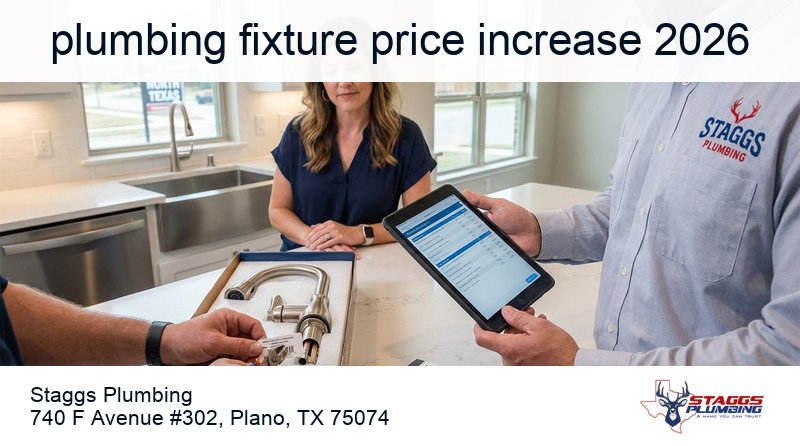
With 40+ years of direct visibility into wholesale pricing trends across DFW supply houses like Ferguson and Morrison Supply, Staggs Plumbing (TX License #17697) provides upfront, flat-rate quotes on tablet before work begins. There are no surprise inflation adjustments between your quote and your final invoice. That pricing transparency matters more than ever when costs are moving targets.
Frequently Asked Questions
Will plumbing fixture prices ever come back down?
Will plumbing fixture prices ever come back down?
Some relief is possible if tariff policy shifts, but raw material costs and labor shortages are structural issues unlikely to reverse quickly. Industry analysts expect a “new normal” pricing plateau rather than a return to pre-2021 levels. The most realistic expectation is slower increases, not decreases.
Does buying American-made fixtures avoid the tariff surcharge?
Does buying American-made fixtures avoid the tariff surcharge?
Partially. Domestic manufacturers aren’t subject to import tariffs, but they still face elevated raw material costs for copper, brass, and zinc. American-made fixtures may carry a smaller premium than import-heavy brands, but they aren’t immune to overall market inflation.
Are there government rebates that offset higher water heater prices?
Are there government rebates that offset higher water heater prices?
Yes. The federal Energy Efficient Home Improvement Credit covers qualifying high-efficiency and heat pump water heaters, potentially offsetting $300 to $2,000 of the purchase price. Oncor and local utility programs also offer rebates on ENERGY STAR-rated models. Staggs Plumbing provides the manufacturer documentation needed for both federal tax credits and utility rebate applications.
Should I buy my own fixtures to save money?
Should I buy my own fixtures to save money?
This is tempting but carries risk. Homeowner-supplied fixtures typically void the installer’s warranty on the fixture itself, and compatibility issues (wrong valve type, missing trim components) can add to labor costs. Most licensed plumbing companies, including Staggs Plumbing, can source fixtures at contractor pricing that’s competitive with retail, while keeping the full warranty intact.
How do rising costs affect the repair-vs-replace decision?
How do rising costs affect the repair-vs-replace decision?
Higher replacement costs make repair more attractive for younger fixtures (under 7 years old). But for aging equipment near end of life, the math still favors replacement since repair costs are also rising, and an older fixture that fails completely during the next price increase cycle will cost even more to replace. The breakeven point is typically when repair costs exceed 50% of replacement cost on equipment over 8 years old.
Ready to get ahead of the next price increase? Staggs Plumbing has served DFW homeowners for over 35 years with upfront pricing, A+ BBB-rated service, and the honest guidance you need to make smart decisions in a rising-cost market. Call 682-284-0966 to lock in current pricing on your next plumbing project.
If you enjoyed this article, check out these other articles regarding General Plumbing:
Texas Now Charges $4,000 Per Violation for Unlicensed Plumbing
What It Takes to Earn a Texas Master Plumber License in 2026