



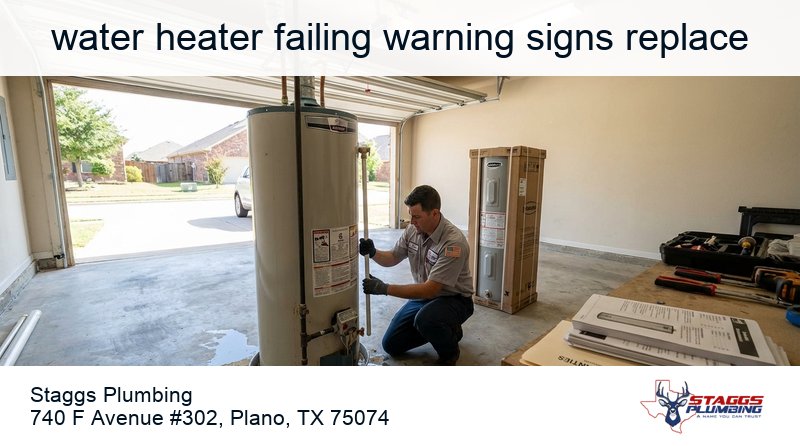
7 Warning Signs Your Water Heater Is Failing
If something feels off with your water heater, trust that instinct. Lukewarm showers, rust-colored water, puddles on the floor, strange banging sounds from the tank: these aren’t quirks to ignore. They’re your water heater telling you it’s on its way out.
Most tank water heaters in North Texas generally last 8 to 12 years with proper maintenance, and closer to 6 to 8 years without it, though actual lifespan can vary. If your unit is past the 10-year mark and showing any symptoms, you’re likely looking at replacement rather than repair. A failing water heater rarely improves on its own. The worst outcome is a burst tank flooding your garage, utility closet, or living space, which can potentially cause $3,000 to $10,000 or more in water damage, depending on the extent and location of the flood.
Here’s what you need to know right now: a leaking tank base almost always means replacement. Rusty hot water usually signals internal corrosion that can’t be reversed. Rumbling and popping noises point to heavy sediment buildup stressing the tank walls. And if you’ve been calling for repairs every few months, those costs are likely already approaching what a new unit would run you.
The good news is that catching these warning signs early gives you time to plan instead of scrambling during an emergency at 2 AM. Below, you’ll find each warning sign explained, a clear repair-vs-replace decision framework, and what to expect if replacement is the right call.
How Old Is Your Water Heater?
Age is the single most reliable predictor of water heater failure. Tank water heaters are designed for a lifespan of roughly 8 to 12 years, but local water conditions, particularly hardness, can shorten that window.
Tap water in many parts of North Texas can test at 18+ grains per gallon (gpg) hardness. That mineral-heavy water accelerates sediment buildup inside the tank and eats through anode rods faster than the national average. A tank that might last 12 years in a soft-water region may reach end-of-life at 8 to 9 years here without annual flushing.
| Unit Age | General Guidance |
|---|---|
| Under 8 years | Repair is usually worth it |
| 8 to 10 years | Weigh repair cost against replacement |
| 10+ years | Replacement is often the smarter investment |
To find your water heater’s age, check the manufacturer’s label on the side of the tank. The serial number typically encodes the manufacture date. The first two digits or a letter code represent the year. If you can’t decode it, a plumber can identify it in seconds during a diagnostic visit.
Rusty or Discolored Hot Water
When only your hot water runs rusty or brown while cold water stays clear, the problem is almost certainly inside the water heater. Internal tank corrosion produces rust particles that mix into your hot water supply.
Every tank water heater has a sacrificial anode rod designed to attract corrosive elements and protect the steel tank lining. Once that rod is depleted (which can occur more rapidly in hard water, often within 3 to 5 years), corrosion goes to work on the tank itself. By the time you see rust in your water, the damage is already significant.
One quick test: drain 3 to 4 gallons from the tank’s drain valve into a white bucket. If the water shows a brownish or reddish tint, internal corrosion is active. On units under 8 years old, replacing the anode rod may buy more time. On older units, rust-colored water is a strong signal the tank’s integrity is compromised and replacement should be on the table.
Strange Noises: Rumbling, Popping, Banging
A healthy water heater operates quietly. When you start hearing rumbling, popping, or banging sounds, sediment has hardened on the bottom of the tank.
Here’s what happens: minerals from North Texas hard water settle on the tank floor and calcify over time. When the burner fires (gas units) or elements heat (electric units), water trapped beneath that sediment layer superheats and creates those noises. The tank is working harder, running longer heating cycles, and the added stress accelerates wear on the tank walls.
On newer units, a professional flush can remove sediment and quiet the tank. On units over 8 to 10 years old where sediment has been building for years, flushing may not fully resolve the problem, and the noise is a warning that tank failure is approaching.
Water Pooling or Leaking Around the Base
A puddle under or around your water heater demands immediate attention. First, rule out other sources: check the T&P (temperature and pressure) relief valve discharge pipe, inlet and outlet connections, and the drain valve. Condensation on cold pipes near the unit can also drip and create misleading puddles.
If the leak is coming from the tank body itself, replacement is the only fix. Tank leaks occur when internal corrosion weakens the steel enough for water to seep through. These leaks tend to worsen quickly. What starts as a slow drip can become a full rupture.
What to do right now if your tank is leaking:
- Turn off the gas or electricity to the water heater
- Close the cold water supply valve above the unit
- Attach a garden hose to the drain valve and route water outside or to a floor drain
- Call a licensed plumber for same-day evaluation
Acting fast limits water damage and gives you options. Waiting turns a planned replacement into an emergency.
Inconsistent Water Temperature or Slow Recovery
Running out of hot water faster than usual, getting lukewarm water when you used to get hot, or experiencing temperature swings mid-shower all point to declining performance.
Common causes depend on your unit type:
| Symptom | Gas Unit Cause | Electric Unit Cause |
|---|---|---|
| No hot water | Failed thermocouple, pilot, or gas valve | Failed element or thermostat |
| Lukewarm only | Broken dip tube or sediment | Failed upper element |
| Runs out quickly | Sediment reducing tank capacity | Failed lower element |
| Temperature swings | Thermostat drift or gas valve issue | Thermostat calibration |
Some of these are repairable. A failed heating element on an electric unit costs far less to fix than a full replacement. But if your unit is over 10 years old and experiencing multiple symptoms from this list, the cumulative repairs rarely pencil out.
Rising Energy Bills With No Other Explanation
A water heater can typically account for 15% to 20% of a home’s energy costs, though this percentage varies by household. As a unit ages and sediment accumulates, it loses efficiency. The burner or elements run longer cycles to reach the set temperature, and your gas or electric bill reflects that extra work.
If your energy costs have crept up and you’ve ruled out HVAC changes, seasonal swings, and rate increases, your water heater is a likely contributor. A unit that was 90% efficient when new might operate at 70% or less after years of sediment buildup. That efficiency loss translates to $15 to $30+ per month in wasted energy, depending on usage and fuel type.
Replacing an old, inefficient unit with a new high-efficiency or ENERGY STAR model can cut water heating costs by 10% to 30% and starts paying for itself immediately.
Frequent Repairs Adding Up
One repair is normal. Two in a year is a pattern. Three or more on a unit over 8 years old is a clear signal to stop investing and start replacing.
The “50% rule” is a common guideline: if a single repair costs more than 50% of what a new water heater installation would run, many experts suggest replacement is the better financial move. And if you’ve spent $500 or more on repairs in the past 12 months on an aging unit, that money would have been better applied toward a new system with a full warranty.
| Scenario | Recommendation |
|---|---|
| 1 repair, unit under 8 years | Repair and monitor |
| 2+ repairs, unit 8 to 10 years | Get a replacement quote to compare |
| Any repair over 50% of replacement cost | Replace |
| 3+ repairs in 12 months, any age | Replace |
Repair vs. Replace: How to Make the Call
When you’re weighing repair against replacement, these 4 factors give you a clear answer:
- Age: Over 10 years in North Texas hard water conditions tips toward replacement
- Repair history: Multiple repairs in the past year signal systemic decline, not isolated issues
- Symptom severity: A leaking tank base or active internal corrosion can’t be repaired, only replaced
- Repair cost vs. replacement cost: Apply the 50% rule
If 2 or more of those factors point toward replacement, that’s your answer. A new water heater installed by a licensed plumber comes with manufacturer warranties (6 to 12 years on tanks), labor warranties, and modern efficiency standards. That’s a reset, not just another patch.
What to Expect When You Replace Your Water Heater
Knowing what the process looks like takes the stress out of the decision:
- Timeline: A standard tank replacement takes 2 to 4 hours. Same-day service is available when units are in stock.
- Cost range: Tank water heater replacement in the Plano area, and through our services, typically runs $1,200 to $2,500+ depending on unit size, fuel type, and any code upgrades needed.
- Permits: Most DFW municipalities require a permit for water heater replacement. A licensed plumber handles the permit, installs to current code, and coordinates the city inspection.
- Old unit disposal: Your old water heater is removed and recycled.
- Warranties: Expect manufacturer tank and parts coverage (6 to 12 years depending on model) plus labor warranties from your installer.
Financing options, including 0% APR for 12 months on qualifying installations, can make the investment manageable without waiting for an emergency to force the decision.
Frequently Asked Questions
How do I find the age of my water heater from the serial number?
How do I find the age of my water heater from the serial number?
Look at the manufacturer’s label on the tank. Most brands encode the manufacture date in the first characters of the serial number. Rheem and Ruud use a month-year code (e.g., 0718 = July 2018). AO Smith uses a letter for the year. If you can’t decode it, any plumber can identify the age in seconds.
Does my water heater warranty cover replacement?
Does my water heater warranty cover replacement?
Manufacturer warranties cover the tank and internal parts for 6, 9, or 12 years depending on the model. If your tank fails within that window due to a manufacturing defect, the replacement tank is covered, though labor may not be. Check your original install paperwork or contact the manufacturer with your serial number.
Can I replace my water heater myself, or do I need a licensed plumber?
Can I replace my water heater myself, or do I need a licensed plumber?
While local municipal codes often require a licensed plumber for permitted water heater installations for safety and compliance, and it is strongly recommended, state law regarding this can be nuanced. Always check with your local municipality for specific requirements. Beyond the legal requirement, professional installation ensures gas connections are leak-tested, venting meets current code, the T&P valve discharges correctly, and permits are pulled and inspected. DIY water heater installs can void manufacturer warranties and create safety hazards.
Is a tankless water heater worth the extra cost when replacing a tank unit?
Is a tankless water heater worth the extra cost when replacing a tank unit?
Tankless units cost more upfront but generally have a longer lifespan of 15 to 20+ years, provide continuous hot water within their flow limits, and can use 20% to 30% less energy for households with high hot water demand compared to tank units. For households with high hot water demand or concerns about tank failure, the long-term value often justifies the higher initial cost.
What happens if a water heater bursts while I’m not home?
What happens if a water heater bursts while I’m not home?
A burst 40 to 50-gallon tank can release its full volume in minutes, plus the incoming water supply continues flowing until someone shuts it off. The result is significant flooding, potential structural damage, and mold risk. This is the strongest argument for proactive replacement when warning signs appear rather than waiting for failure.
Staggs Plumbing has served Plano and the DFW metroplex since 1990. With 40+ years of hands-on water heater experience, Texas Master Plumber License #17697, and an A+ BBB rating backed by 530+ verified reviews, we diagnose water heater problems honestly and replace units to code with a 2-year labor warranty. Same-day replacement is available, and we offer 0% financing on qualifying installations. Call 682-284-0966 to schedule a water heater evaluation.
If you enjoyed this article, check out these other articles regarding Water Heater:
7 Real Dangers of DIY Water Heater Installation
What Size Water Heater Tank Do I Need?